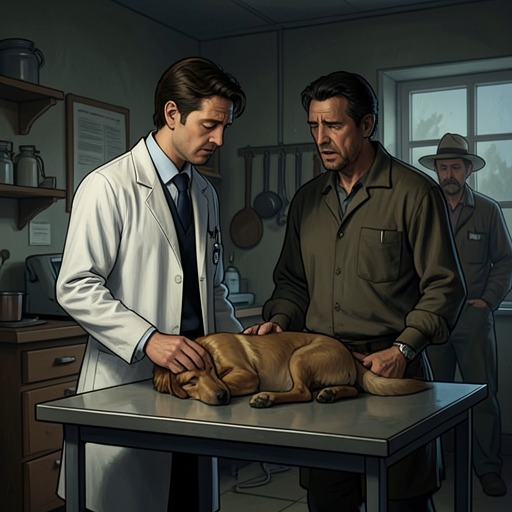
Retropharyngeal abscess in Strawberry
All Creatures Great and SmallStrawberry’s retropharyngeal abscess turned a promising dairy cow’s minor swallowing difficulty into a rapidly worsening threat to her breathing, and forced James Herriot to attempt an operation he had never performed or seen. The case became both a dramatic recovery and a lesson in the gap between a successful outcome and sound clinical judgment: Strawberry survived, but Herriot later considered the treatment wrong from its beginning.
Early signs and diagnosis
About a month after Herriot had seen Strawberry in Dick Rudd’s byre, Rudd asked him to examine her again. The cow had been producing milk well, but that morning she seemed amiss. She did not initially appear seriously ill and was still eating. Her temperature was normal and her lungs were clear; the small clue was a slight gulp when she swallowed and a faint snoring sound when Herriot stood beside her head.
Herriot suspected inflammation or the beginning of an abscess behind the throat. He knew that such abscesses could be dangerous because of their inaccessible position: if one grew large, it could interfere severely with breathing. His previous experience had been limited to abscesses that were small enough to subside or rupture by themselves, so his initial expectation rested on the possibility that Strawberry’s might resolve in the same way.
He injected Prontosil and instructed Rudd to apply hot-water fomentations behind the angle of the jaw, followed by salve, at least three times a day. The treatment was intended to encourage the abscess to burst. Herriot continued to check the cow over the next ten days, but the abscess steadily developed rather than rupturing. Strawberry was not acutely ill at first, yet she ate less, lost weight, and produced less milk. Herriot recognized that the injections were doing little to address the central problem: in his assessment, relief depended on the abscess opening, and that was taking too long.
Deterioration and the decision to operate
The timing made the case more difficult. Siegfried Farnon left for a week-long equine conference, leaving Herriot stretched by the work and with little time to think about Rudd’s cow. When Rudd came to see him, he was cheerful as usual but visibly strained, and reported that Strawberry had declined sharply over the previous three days.
Herriot hurried to Birch Tree Farm. Strawberry, once a show cow, had become gaunt; she was breathing with a rasp, exhaling with an unusual puffing of her cheeks, and coughing painfully. Her eyes remained fixed on the wall. The contrast between her earlier good condition and her present weakness made the failure of the wait-and-see approach plain. By the time Herriot reached her again, she had used up almost all her strength merely walking to the box. She was down on her chest, with her head extended, nostrils dilated, and cheeks puffing as she fought for breath. Her survival at that moment gave Herriot a reason to act, but little time in which to find a conventional solution.
Herriot told Rudd that the abscess was not going to rupture in time and that he had to operate. He also made clear how uncertain the plan was: the only approach he could think of was from behind the jaw, although he had never done it, witnessed it, or heard of anyone doing it. The large blood vessels in the area made a misplaced cut potentially fatal. Rudd judged that Strawberry could not last much longer and agreed that there was little left to lose.
An unfamiliar approach
Because Strawberry was so weak, she did not need to be pulled down with ropes or given a general anaesthetic. A gentle push at the shoulder was enough to roll her onto her side, where she lay still. Herriot used local anaesthetic beneath the ear and along the angle of the jaw, then positioned her head straight out and slightly back.
The operation required Herriot to work through the muscle behind the jaw while keeping the nearby vessels in mind. Although he had cleared a small space, his hand began to tremble and he could not bring himself to continue with the scalpel. He changed instruments, pushing long artery forceps through the opening instead. When a trace of pus appeared on the metal, he realized that he had reached the abscess. Opening the forceps widened the drainage passage, and the contents flowed out. This unexpected confirmation that he had found the target transformed a speculative procedure into an effective one, though the immediate success did not yet establish that Strawberry would survive.
The operation’s importance lay not in Herriot’s confidence but in its absence. He had no established technique to rely on and faced a decision under the pressure of the cow’s worsening breathing. Rudd’s consent acknowledged the urgency, while Herriot’s switch from scalpel to forceps marked the crucial practical turn: he stopped before making the cut he feared and used the instrument to find and open the abscess.
Recovery and retrospective assessment
Herriot left the farm with little hope. He believed that if the abscess walls had been going to collapse, they would already have done so, and suspected that he should have referred Strawberry even though he thought she would die before morning. He therefore did not hurry to Birch Tree Farm the next day. When he finally opened the box door, he expected to find the familiar signs that a patient had died and been removed.
Instead, Strawberry was standing and eating hay. She was still extremely thin and weak, and her udder had shrivelled, but she swallowed without difficulty; the noisy, laboured breathing and salivation were gone. Herriot sat in the straw and watched her eat, gradually accepting that the improvement was real. Three weeks later, her bones were covered with flesh again, her skin shone, and her udder had filled out. The speed and completeness of this recovery made the case one of Herriot’s personal triumphs.
That satisfaction remained qualified. Looking back, he concluded that he had done hardly anything right from the start. He believed that he should have entered through the cow’s mouth much earlier, but at the time he did not know how to do so. In later years he opened many such abscesses through the mouth, using a mouth gag and a scalpel secured to his fingers; he described that method as hazardous because a cow or bullock could throw itself down while he was working with his arm deep inside. The later technique gave him a clearer procedure, but it did not erase the uncertainty of the first operation or the particular satisfaction of Strawberry’s recovery.
Clinical context and significance
Herriot’s account places Strawberry’s illness within a form of veterinary work whose methods changed over time. He observed that younger veterinarians were often unfamiliar with these abscesses because most were believed to have a tuberculous origin and they became rare after attestation. For veterinarians of his own generation, the case could still call up memories of a condition and a difficult practical response that were no longer common in the same way.
The episode also distinguishes outcome from competence. Strawberry’s survival followed the drainage, and the relief of her breathing and return to condition were concrete results; nevertheless, Herriot did not turn that success into proof that his earlier decisions had been sound. His retrospective judgment preserves the uncertainty that accompanied the case: he had waited while the abscess worsened, tried measures he later regarded as inadequate, and finally acted with an improvised method because delay seemed more dangerous. Strawberry’s recovery is therefore both the resolution of the crisis and the reason the case endured in Herriot’s memory as a triumph achieved by doing it the wrong way.